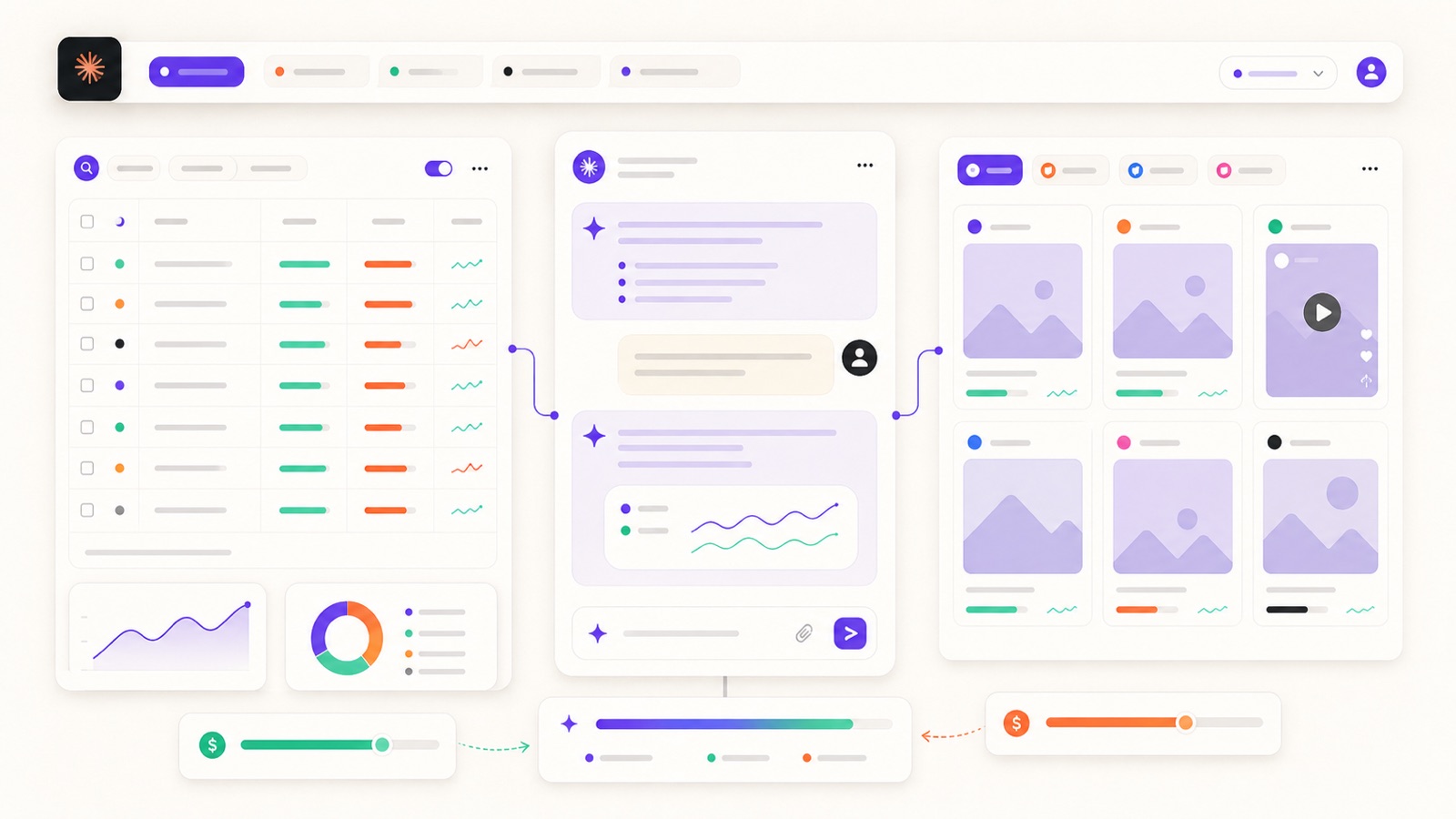
- Single-platform AI can't go cross-channel — by design. Google's bidding can't see Meta; Meta's can't see Google. Each optimizes its own box and calls it a day.
- The missing job is reallocation. Comparing blended ROAS and moving budget Google↔Meta is the one decision neither platform's AI is even allowed to make.
- One agent, both accounts. 1ClickReport connects Google Ads, Meta, GA4, Search Console and Stripe to Claude — so one chat sees the whole picture and one report covers it all.
- It acts only with approval. Read-only audits, paused-by-default campaigns, and your sign-off on every budget move.
The blind spot at the center of multi-channel advertising
Almost every business that advertises runs at least two channels: Google Ads to catch demand that already exists, and Meta (Facebook & Instagram) to create it. Both platforms have spent years building genuinely good AI — Google's Smart Bidding, Meta's Advantage+. They squeeze remarkable efficiency out of every dollar you hand them.
But notice what each one optimizes: itself. Google's AI makes your Google spend as efficient as it can. Meta's AI makes your Meta spend as efficient as it can. Neither has any idea the other exists. There is no setting in Google Ads that says "if Meta is doing better this week, send some of my budget there," and there never will be — Google has no incentive to route your money to a competitor, and no access to do it.
So the most important question in cross-channel advertising goes permanently unanswered by the platforms themselves: across Google and Meta combined, where is the next dollar best spent? That decision sits in the gap between two AIs that each refuse to look up from their own dashboard. For most advertisers, nobody is answering it at all — they just keep last quarter's split because re-deciding it by hand means exporting two sets of numbers and arguing with a spreadsheet.
This is the one thing single-platform AI structurally cannot do. Not "doesn't do well yet" — cannot, because it can't see the other side. An agent that holds both accounts in one view can. That gap is the entire reason this post exists.
Why single-platform AI fails at the cross-channel decision
It's worth being precise about why, because the failure isn't a bug to be patched — it's the boundary of what each tool can see.
- Google's AI is blind to Meta. Smart Bidding can hit a target ROAS inside Google all day long. It has zero visibility into whether your Meta prospecting is feeding those branded Google searches in the first place — or whether Meta is quietly out-earning Google this month.
- Meta's AI is blind to Google. Advantage+ will happily scale a Meta campaign to its efficiency ceiling. It cannot tell you that the same $500 would return more in a Google shopping campaign that's currently budget-capped.
- Each reports its own flattering number. Both platforms claim credit for the same conversions. Add their self-reported ROAS together and you get a fantasy — you can't reallocate against numbers that double-count.
- Neither is allowed to move your money to the other. Even if Google's AI knew Meta was winning, it has no mechanism — and no commercial reason — to hand budget to a rival platform.
The result: two locally-optimized channels and a globally-wrong budget split. You can be running near-perfect campaigns on both platforms and still leave real money on the table, simply because the line between them is where the decision lives and no platform AI is standing there.
The fix: give one agent a view of both
MCP (Model Context Protocol) is the open standard that lets an AI app securely connect to live data sources. 1ClickReport is an MCP server for marketing: you connect Google Ads, Meta, GA4, Search Console and Stripe with OAuth, and from then on Claude can read — and, on the Team plan, act on — all of them from one conversation.
That single detail changes everything about cross-channel work. Claude isn't asking Google's AI and Meta's AI to cooperate (they can't). It's holding both accounts itself, in one context window, and reasoning across them the way a sharp media buyer would — except it does the math in seconds and never forgets to check GA4 for what actually converted.
Ask it the question the platforms can't:
Claude queries both live accounts plus GA4, reconciles the numbers, and answers with one comparison — not two dashboards you have to mentally merge. From there, every cross-channel job becomes a sentence.
The cross-channel jobs only a both-platforms agent can do
"Manage Google + Meta from one chat" isn't a slogan — it's a specific set of jobs that are impossible inside any single platform. Here are the ones that move the needle.
1. One unified view of both platforms
The foundation. Instead of Google Ads in one tab and Meta Ads Manager in another, you get spend, results, CPA and trend for both channels in a single answer — already normalized so you're comparing like with like.
2. Blended ROAS, not platform-reported fiction
Because GA4 and Stripe are connected too, Claude can tie performance to real revenue and compute true blended ROAS across channels — the honest number neither platform will show you, because neither can see the whole funnel.
3. Shift budget Google ↔ Meta
The headline job. Based on blended ROAS, Claude recommends moving budget toward the channel that's actually earning more — then, on Premium and with your approval, adjusts the campaign budgets on both sides for you. (Full worked example below.)
4. Dedupe overlapping audiences
Retargeting the same buyers on both Google and Meta? You're paying twice to reach one person and inflating both platforms' "conversions." Claude can spot overlapping audience and remarketing setups across channels and suggest where to cut the double-spend.
5. Spot the channel that's actually winning
Sometimes the "expensive" channel is the one creating the demand the "cheap" channel harvests. An agent looking at both — plus GA4 paths — can surface that relationship instead of letting last-click reporting bury it.
6. One cross-channel report
Board-ready, client-ready, "what changed across Google and Meta and why" — pulled live from both accounts in seconds. One report, both platforms, no copy-paste from two exports.
A concrete example: reallocating $1,000 across Google and Meta
Here's the kind of decision that's trivial for a both-platforms agent and nearly impossible to make cleanly by hand. Say last month looked like this, with revenue pulled from GA4/Stripe rather than the platforms' own claims:
| Channel | Spend | Revenue (GA4/Stripe) | Blended ROAS |
|---|---|---|---|
| Google Ads | $5,000 | $22,500 | 4.5× |
| Meta Ads | $5,000 | $14,000 | 2.8× |
| Blended | $10,000 | $36,500 | 3.65× |
Google's AI sees a healthy 4.5× and is content. Meta's AI sees 2.8×, decides that's fine for its objective, and keeps spending. Neither one is wrong inside its own box — and together they're leaving money on the table, because the marginal dollar is clearly worth more on Google right now. You ask:
Claude checks which Google campaigns are budget-capped (so the extra spend won't just inflate CPCs), identifies the lowest-ROAS Meta ad sets to pull from, and shows you the plan: −$1,000 on two underperforming Meta ad sets, +$1,000 split across two Google campaigns that were leaving impression share on the table. If the new dollars hold even close to Google's current efficiency, that single move lifts blended return without spending a cent more. You read the plan, click approve, and Claude makes the budget changes on both platforms. No platform AI on earth would have proposed it, because no platform AI can see both sides of the trade.
Single-platform AI vs a cross-channel agent
| Capability | Google's AI | Meta's AI | Claude + 1ClickReport |
|---|---|---|---|
| Optimize within its own platform | Yes | Yes | Yes |
| See the other platform's data | No | No | Yes |
| Compare true blended ROAS | No | No | Yes |
| Shift budget between Google & Meta | No | No | Yes (with approval) |
| Dedupe overlapping audiences across channels | No | No | Yes |
| One report covering both platforms | No | No | Yes |
| Tie performance to real revenue (GA4/Stripe) | Partial | Partial | Yes |
Every "No" in those middle columns isn't a temporary gap — it's the edge of what a single-platform tool is structurally able to do. The whole right-hand column exists only because one agent holds both accounts at once.
"You stay in control" — how budget moves stay safe
Letting anything shift money between two ad platforms sounds risky until you see how it's gated. 1ClickReport is approval-based by design:
- Audits and comparisons are read-only. Pulling blended ROAS or checking audience overlap can't change anything in your accounts.
- New campaigns are created paused. Nothing spends until you review and enable it.
- Every budget move needs approval. Claude proposes the reallocation and shows the before/after; the change to Google and Meta only happens after you confirm.
- Spend protection. Daily caps and 24/7 monitoring agents flag anomalies on either platform before they cost you.
See Google + Meta in one chat — free for 7 days
Connect Google Ads, Meta, GA4 & Stripe in about 60 seconds. Compare blended ROAS, find the channel that's actually winning, and reallocate budget — with approval on every move, all inside Claude.
Go deeper: the full cross-channel playbook
This is the cross-channel decision. Here's the wider system it sits inside, and the per-channel deep dives:
Frequently asked questions
What is cross-channel advertising?
Running and optimizing campaigns across more than one platform — typically Google Ads and Meta (Facebook & Instagram) — as a single system rather than in separate silos. The goal is to compare performance like-for-like and move budget to wherever it earns the best return, instead of optimizing each platform on its own.
Why can't Google's or Meta's own AI handle cross-channel optimization?
Each platform's AI is blind to the other. Google's Smart Bidding optimizes inside Google and can't see your Meta numbers; Meta's Advantage+ optimizes inside Meta and can't see Google. Neither can answer "across both, where is the next dollar best spent?" — that needs an agent holding both accounts in one view, which is what 1ClickReport gives Claude.
What is blended ROAS and why does it matter?
Blended ROAS is total revenue divided by total ad spend across all channels, instead of each platform's self-reported ROAS. Platform numbers double-count conversions and flatter each channel, so they can't be summed. Blended ROAS — tied to real revenue from GA4 and Stripe — is the honest number to reallocate budget against.
Can Claude actually move budget between Google and Meta for me?
Yes, on the Team plan and only with your approval. Claude recommends a reallocation based on blended ROAS, then — once you confirm — adjusts Google and Meta campaign budgets directly. Audits are read-only, new campaigns are created paused, and no budget change takes effect until you approve it.
Which platforms does 1ClickReport connect for cross-channel work?
Google Ads, Meta (Facebook & Instagram), GA4, Search Console, and Stripe — all via OAuth. The ad platforms give you spend and performance; GA4 and Stripe give you real conversions and revenue, which is what makes blended ROAS trustworthy.