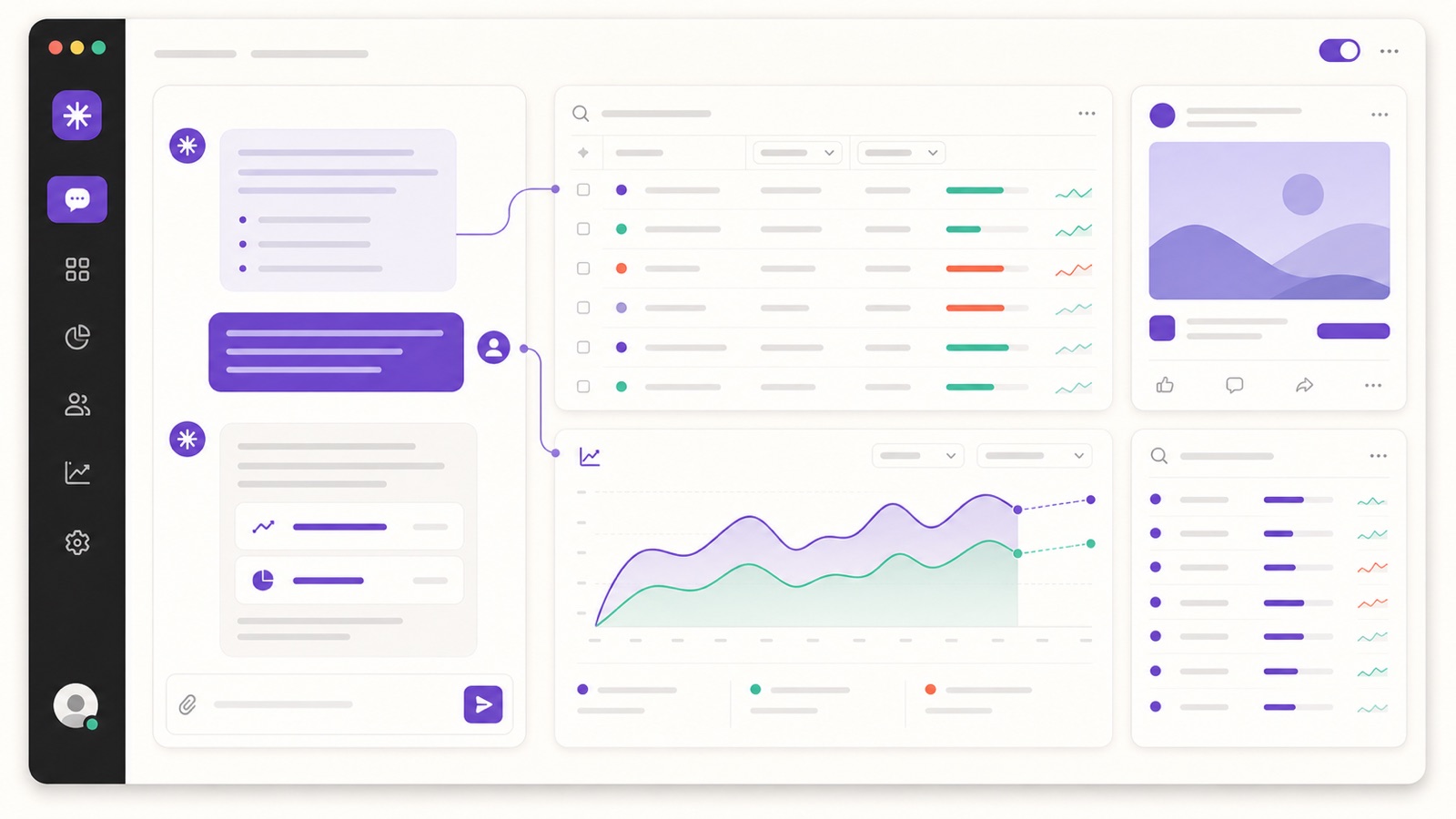
- "Automation" has changed meaning. The old version was fixed if-then rules. The 2026 version is an AI agent that reasons over your data and acts on your approval.
- The unlock is MCP. Connecting Claude to your live Google Ads, Meta, GA4, Search Console and Stripe lets you run everything by asking in plain English.
- Cross-channel is the edge. No single-platform AI can move budget from Meta to Google based on blended ROAS. An agent that sees both can.
- You stay in control. Read-only audits, paused-by-default campaigns, approval on every change.
What "AI marketing automation" actually means in 2026
For a decade, "marketing automation" meant rules. You logged into a platform, configured an if-this-then-that trigger — "if CPA > $40, lower the budget 10%" — and hoped the rule still made sense next month. It rarely did. Rules are brittle: they can't tell the difference between a bad week and a broken campaign, they don't see other channels, and they only do exactly what you pre-programmed.
The 2026 version is different in kind, not degree. Instead of triggers, you have an AI agent that reasons over your live data. It can diagnose why your cost per result jumped, weigh a trade-off you never thought to encode, notice that your Meta budget is starving a profitable Google campaign — and propose the fix in plain language. That is the shift: from scripted reactions to reasoned recommendations.
The most capable form of this today is Claude connected to your marketing accounts — and that connection is what makes it real rather than a chatbot guessing from a screenshot.
Why the old way breaks: four dashboards and a spreadsheet
Walk through a normal Monday. You open Google Ads to check spend. Then Meta Ads Manager for creative performance. Then GA4 to see what actually converted. Then Search Console for organic. Then a spreadsheet to stitch it together because none of those tools talk to each other. By the time you have a picture, it's stale and you're out of time to act on it.
Every one of those tools has its own AI now — but each is blind to the others. Google's AI can't see your Meta numbers. Meta's AI can't see what converted in GA4. None of them can answer the question that actually matters: "Across everything I'm spending, where is the next dollar best spent?"
The core problem isn't a missing feature — it's a missing vantage point. Performance lives in five places, and decisions need all five at once. That's exactly the gap an AI agent connected to all of them fills.
How Claude + MCP changes the workflow
MCP (Model Context Protocol) is the open standard that lets an AI app securely connect to live data sources. 1ClickReport is an MCP server for marketing: you connect Google Ads, Meta, GA4, Search Console and Stripe with OAuth, and from then on Claude can read — and, on the Team plan, act on — all of it from one conversation.
Instead of opening four dashboards, you ask:
Claude queries your live accounts, does the math across both platforms, and answers with the actual numbers and a recommendation. No export, no upload, no waiting. And because it's a conversation, you can keep going: "OK, pause those — but keep the one driving newsletter signups."
The 5 marketing jobs you can put on autopilot
"Run your marketing from Claude" isn't a slogan — it's a concrete set of jobs. Here are the five that move the needle, each with a starter prompt.
1. Find wasted spend (the weekly audit)
The single highest-ROI task. Claude scans your accounts for fatigued creatives, budget concentrated on losing ad sets, broad keywords burning money, and placements with collapsing CTR.
2. Bid & budget management
Instead of brittle rules, Claude reasons about pacing and reallocation — then proposes specific changes you approve. New budgets never go live until you say so.
3. Creative fatigue & scaling on Meta
Claude watches frequency and CTR decay, flags creatives past their fatigue point, and identifies winners worth scaling — with the budget math attached.
4. Cross-channel reallocation
The one only an agent that sees both platforms can do: shift budget from the weaker channel to the stronger one based on blended ROAS, not platform-reported numbers.
5. Reporting that writes itself
Board-ready summaries, client updates, and "what changed and why" — pulled live, in your words, in seconds. The thing you used to spend Friday afternoon on.
"You stay in control" — how it's safe
Autonomy without guardrails is how you wake up to a drained budget. 1ClickReport is built the other way:
- Audits are read-only. Analysis can't change anything in your accounts.
- New campaigns are created paused. Nothing spends until you review and enable it.
- Every change needs approval. Claude proposes; you confirm. It's a driver you steer, not an autopilot.
- Spend protection. Daily caps and 24/7 monitoring agents flag anomalies before they cost you.
AI marketing automation vs the alternatives
| Approach | Cross-channel? | Reasons over data? | You approve changes? |
|---|---|---|---|
| Platform auto-rules | No | No (fixed triggers) | N/A |
| Single-platform AI (Google/Meta) | No | Within one platform | Partial |
| Legacy automation suites | Limited | No | Manual |
| Claude + 1ClickReport (MCP) | Yes | Yes | Yes |
Run your marketing from Claude — free for 7 days
Connect Google Ads, Meta, GA4 & Search Console in about 60 seconds. Analyze, find wasted spend, and approve every change — without leaving Claude.
Go deeper: the channel-by-channel playbooks
This is the overview. Each job above has its own deep guide:
Frequently asked questions
What is AI marketing automation?
An AI model — not just rule-based triggers — that analyzes your marketing data, proposes changes, and executes approved actions across channels. The 2026 form is an agent like Claude connected to your live accounts via MCP, so you run Google Ads, Meta, GA4 and Search Console by asking in plain English.
How is it different from rule-based automation?
Rule-based automation fires fixed if-then triggers you set in advance. AI marketing automation reasons over the data — it can diagnose why performance changed and weigh trade-offs across channels, then act only after you approve.
Will it spend my budget without permission?
No. Audits are read-only, new campaigns are created paused, and every change requires explicit approval. Daily caps and monitoring agents add a second layer of protection.
Which platforms can Claude manage?
Google Ads, Meta (Facebook & Instagram), GA4, Search Console, and Stripe. Analyze all of them; on Premium, create and manage Google and Meta campaigns — all from one chat.
Do I need to be technical?
No — connect with OAuth in ~60 seconds and ask in plain English. If you prefer the terminal, you can also build agents in Claude Code, but it's optional.